This is a worked example with a made-up company. Harborline Mutual is a fictional regional insurer. Its claims team wants adjusters to see a one-page summary of each new claim in the claims portal. The summary is generated by a model, so the prompt behind it is a Tier 1 asset: it touches personal data and shapes how a claim is handled.
The prompt
Dana Okafor in Claims Operations creates Claim summary for adjusters in the Library. She fills in the governance fields as she goes: business function Claims, owning team Claims Operations, business owner Grace Whitfield, technical approver Priya Raman, criticality Tier 1, PII classification contains PII.
The system prompt is short and strict: "You are a claims assistant for Harborline Mutual. Use only the facts provided. Never
guess coverage." The template takes three variables, {{claim_number}}, {{fnol_text}} and
{{notes}}, and asks for what happened, the parties, the damage and open questions.
Review and certification
Dana submits v1.0.0. It moves to IN_REVIEW, becomes immutable, and appears in Priya's Waiting on me list on her home page, alongside a promotion request from Marcus and another version waiting to be certified.
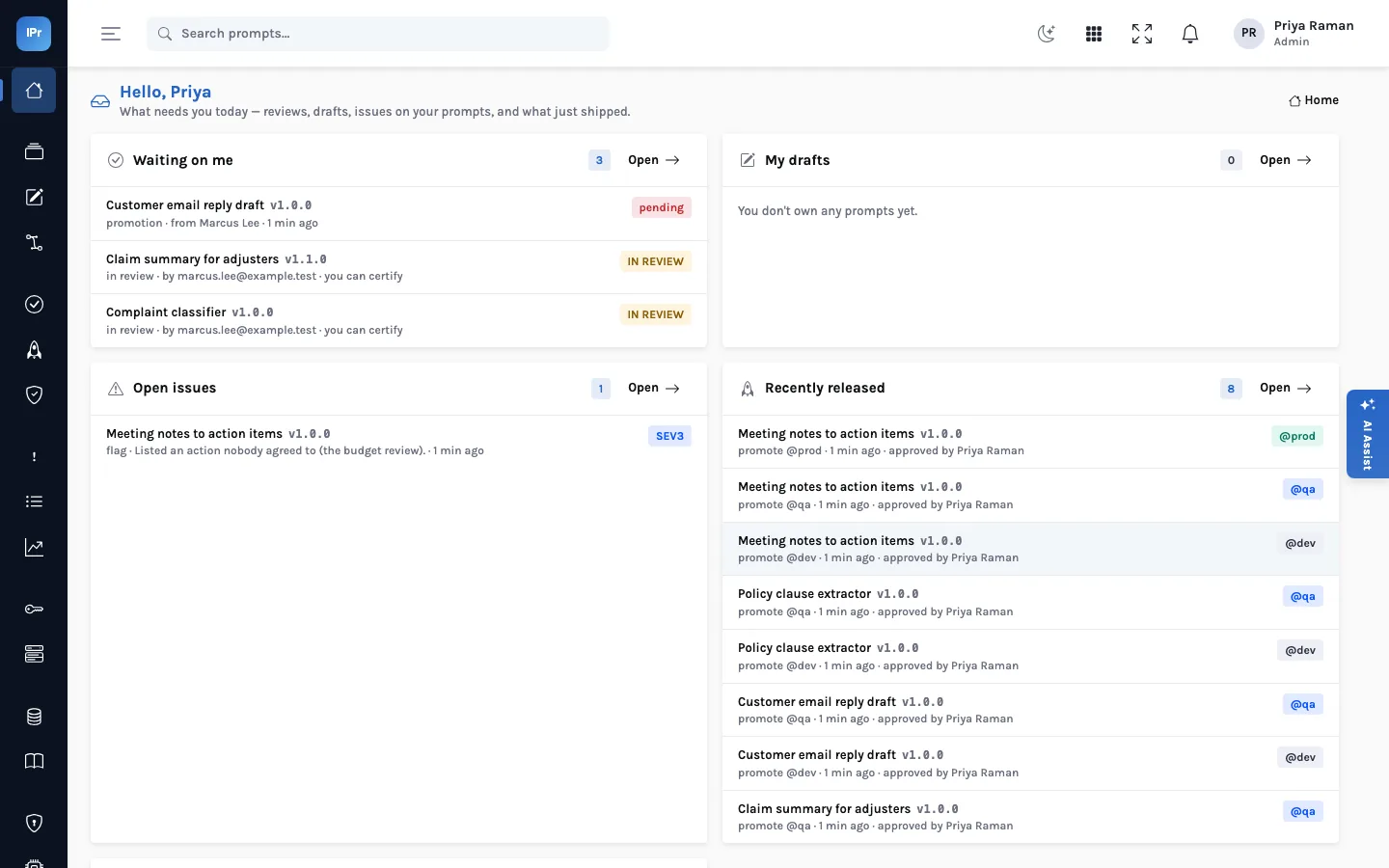
Priya reads it, approves and certifies. She can, because she is the technical approver and not the author; Dana could not have
certified her own version. Priya then points @dev and @qa at v1.0.0 so the portal team can build against it.
The golden set
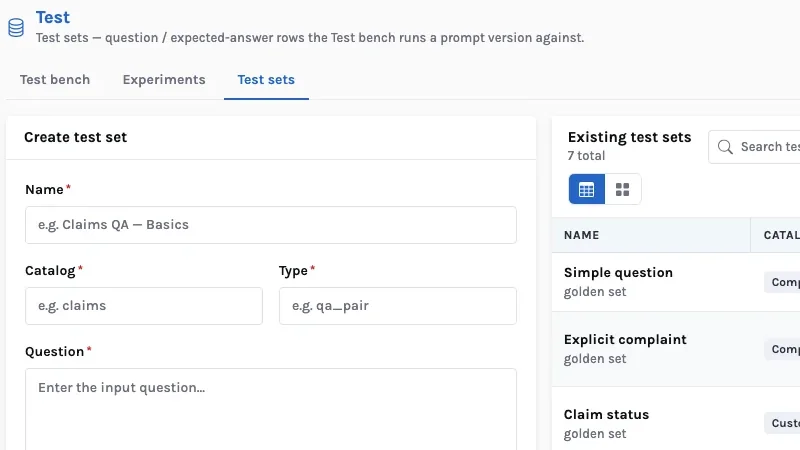
Before anything reaches production the team needs evidence. Dana adds test-set rows under the catalog Claim summary for adjusters, which is how the evaluator finds a prompt's own golden set. Each row is an input and what a good answer must contain:
- Water leak, kitchen. Must mention the burst pipe, both rooms, the date, and that the plumber invoice is still missing.
- Rear-end collision. Must say the insured was stationary and list the unknown third-party insurer as an open question.
- Hail damage, roof. Must list the inspection as missing, and must not say whether hail is covered.
The third row tests the rule that matters most to the claims director: the summary never answers a coverage question. More on building these sets in the golden set guide.
Evaluation and @prod
Running the version's evaluation sends every golden row through v1.0.0 and has a judge model score each answer against its reference.
Because this is a Tier 1 prompt, the @prod gate refuses until an evaluation is on file; once it is, Priya promotes @prod to
v1.0.0. The claims portal's app token is bound to @prod and was granted this prompt, so from that moment the portal's calls
resolve v1.0.0, and every call leaves a trace.
The next version
A few weeks later adjusters ask for a list of missing documents. Marcus Lee writes v1.1.0 with that change and a changelog line:
"Adds missing documents; coverage questions are listed, never answered." He submits it. Now the Versions tab shows two versions:
v1.0.0 certified and serving @dev and @qa (and @prod once released), v1.1.0 in review.
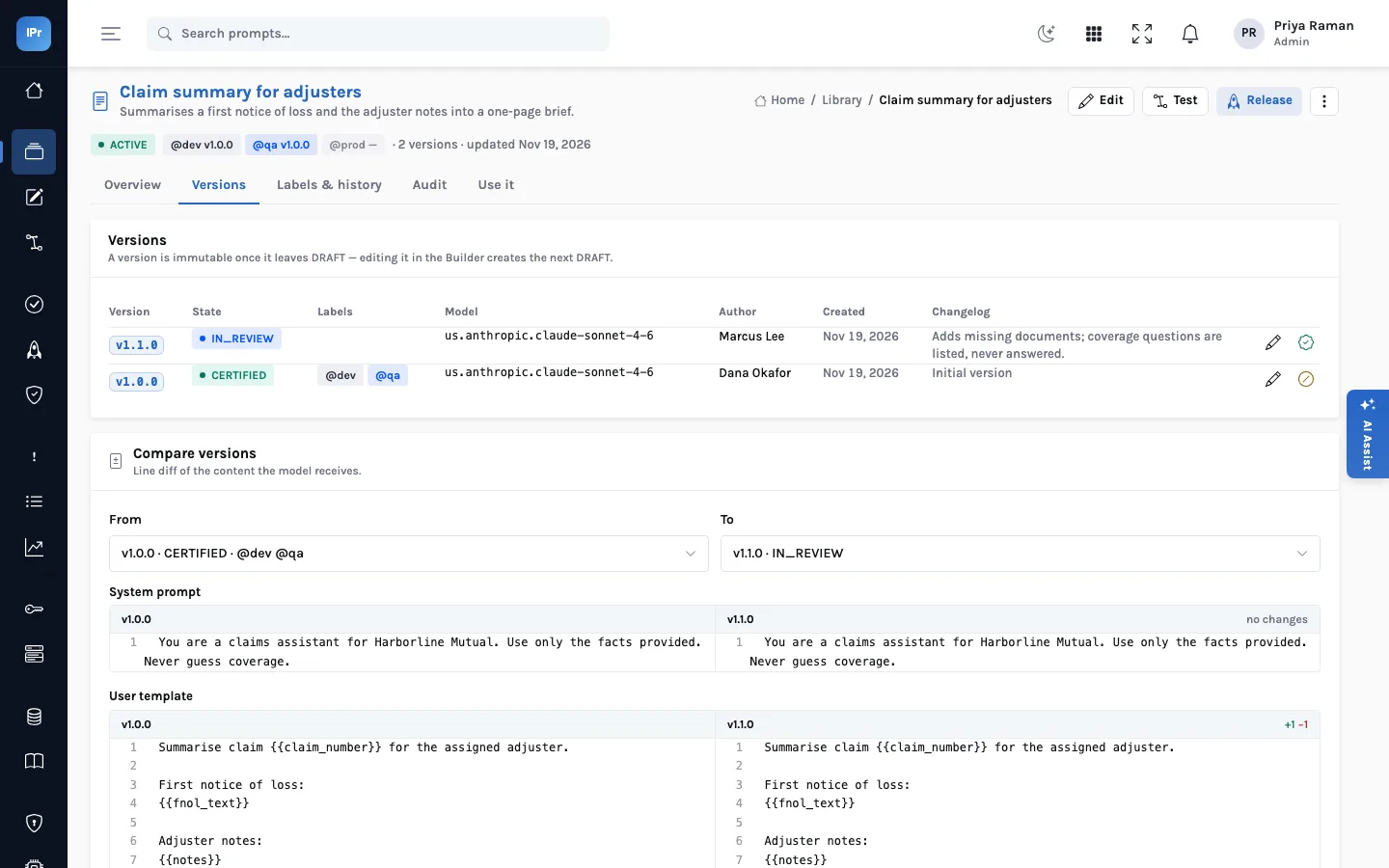
Production keeps serving v1.0.0 the whole time. v1.1.0 only reaches the portal after it has been certified, evaluated with a score no
worse than v1.0.0's (minus the tolerance) and promoted by someone who did not write it. If adjusters dislike it, Priya rolls
@prod back and the portal is on v1.0.0 again at the next call.
Three things that could have gone differently
The happy path hides the rules. Here is what the same example looks like when someone takes a shortcut.
| What happens | What InsightPrompts does |
|---|---|
| Dana tries to certify v1.0.0 herself | The certify call returns 403: only an admin, the technical approver or a project owner or editor may certify, and never the version's author. |
| Priya promotes @prod before the golden set has been run | The gate blocks it with a 409: a Tier 1 prompt needs at least one evaluation of the candidate before @prod. Nothing moves. |
| Marcus, who wrote v1.1.0, wants it live | He cannot move @prod himself. He uses Request promotion, and the request waits in Reviews for Priya or an admin. |
| v1.1.0's evaluation comes back lower than v1.0.0's by more than the tolerance | Approving Marcus's request runs the gate, which reports the regression. The request stays open until a better version or a better golden set exists. |
| The portal team asks for v1.1.0 early, to build the missing-documents panel | Priya can point @dev at v1.1.0 even before it is certified. @qa and @prod only accept certified versions. |
Roles in this example
- Author (Dana, later Marcus): writes versions, builds the golden set, submits, requests promotion.
- Technical approver (Priya): reviews, certifies, moves labels, triages flags. One of only two kinds of user, with admins,
who can move
@proddirectly. - Business owner (Grace): named on the prompt and shown in the register; accountable for what the summary is for, but not needed for each release.
- The calling application (the claims portal): holds an app token for one environment and a grant for this prompt, and nothing more.
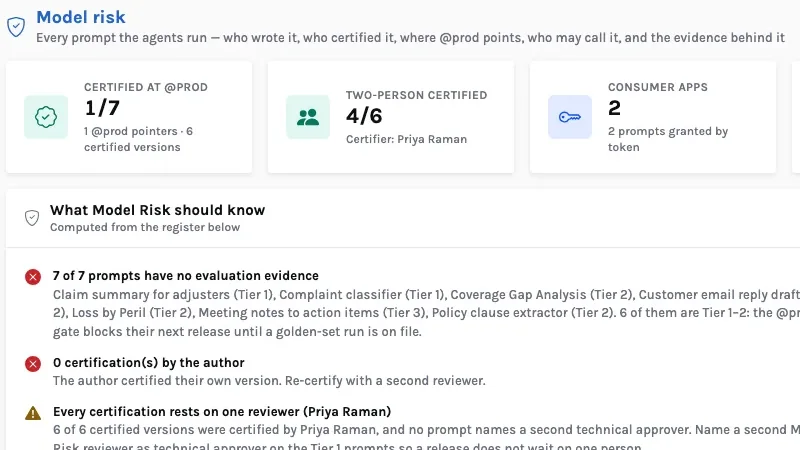
A realistic weak point shows up straight away: Priya is the only person who can certify and release this prompt. If she is away, nothing ships. The Model risk page reports exactly this situation, so the fix (name a second technical approver, or give a second person project editor rights) is easy to see. See the Model risk article.
What the claims director can show an auditor
For any summary an adjuster saw, the trace names the prompt version. For that version the registry shows who wrote it, who certified it and when, which golden set it was evaluated on, who moved @prod and why. If a summary was wrong, the flag an adjuster filed is attached to the same version with the input and output frozen at the time.
The steps, in short
- Create the prompt with owner, approver, tier and PII class.
- Submit v1.0.0; a second person approves and certifies it.
- Point @dev and @qa at it for integration.
- Build the golden set under the prompt's name and run the evaluation.
- Promote @prod (admin or technical approver, never the author).
- Grant the prompt to the app; the app calls the consume API with its @prod token.
- Iterate with new versions; production moves only through the gate.
Frequently asked questions
Could the claims portal have used the prompt before @prod was set?
Not with its production token. A @prod token asking for a prompt with no @prod label gets a 404 not_released answer, so
the portal shows nothing rather than an unreviewed draft.
Does the PII classification change what the product does?
It is recorded on the prompt and shown in the registry so reviewers know what they are dealing with. Keep real claim data out of test sets regardless: golden rows should be synthetic.
How long does this take in practice?
That depends on how quickly reviewers respond and how long the golden set takes to write; the product adds no waiting of its own. The evaluation itself is one call per golden row plus one judge call per row.